

Video Games That Changed the Gaming Industry
Gaming has come a long way from simple arcade machines to massive open worlds, online communities, and highly immersive experiences. Many Video Games That Changed the Gaming Industry did more than entertain players; they introduced ideas that later became standards across the medium. Looking at the Video Games That Changed the Gaming Industry helps us understand how gameplay, storytelling, technology, and business models have evolved. From arcade classics to modern blockbusters, the Video Games That Changed the Gaming Industry continue to influence the games we play today.
How Video Games Transformed Gaming
The history of gaming is filled with moments when a particular title introduced something completely different. Some games made home consoles popular, while others showed developers that video games could tell complex stories or support enormous online communities.
Innovation did not always mean better graphics. Sometimes it came from a simple gameplay mechanic, an unusual control system, a new multiplayer concept, or a different approach to level design. These changes gradually shaped the expectations of players and developers.
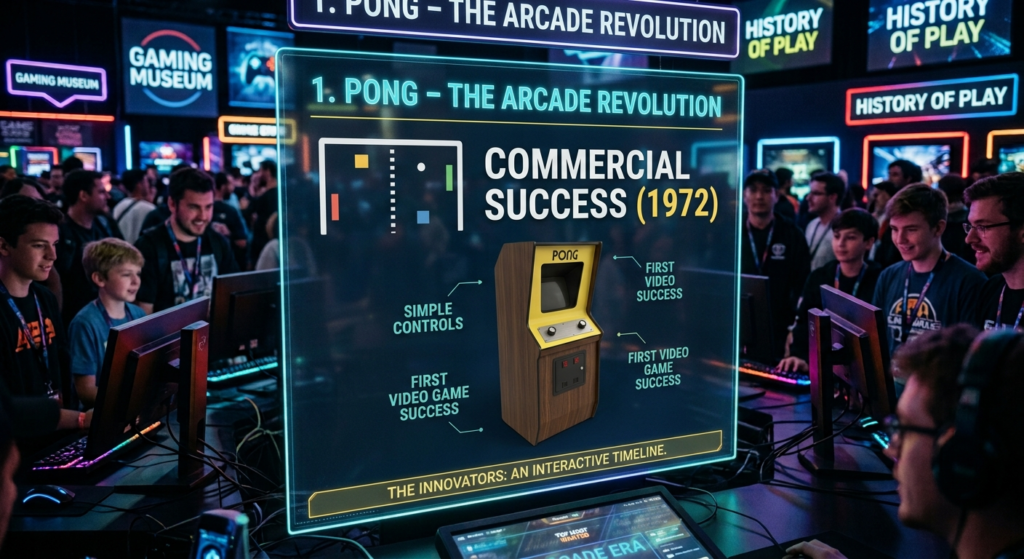
1. Pong – The Arcade Revolution
Released by Atari in 1972, Pong was one of the earliest commercially successful arcade video games. Its concept was incredibly simple: two players controlled paddles and tried to hit a ball past each other.
Despite its simplicity, Pong demonstrated that electronic games could attract a mass audience. Its success helped establish video games as a form of commercial entertainment and contributed to the growth of the arcade industry.
2. Super Mario Bros. – Defining the Platformer
Nintendo’s Super Mario Bros. became one of the most influential platform games ever made. Its colorful worlds, precise controls, memorable enemies, secrets, and level progression created a formula that countless games later adopted.
The game also helped demonstrate the potential of home consoles. Instead of playing a short arcade-style experience, players could explore multiple levels and gradually improve their skills.
3. Tetris – Simple Gameplay With Global Appeal
Tetris proved that a game did not need complex characters or elaborate worlds to become a worldwide phenomenon. Its falling-block mechanic was easy to understand but difficult to master.
The game’s success across different platforms, particularly on the Game Boy, showed the potential of portable gaming. It also demonstrated how an extremely simple concept could remain engaging for players of different ages and backgrounds.
4. The Legend of Zelda – Expanding Player Exploration
The Legend of Zelda introduced a greater sense of exploration and discovery to console gaming. Instead of simply moving through a predetermined sequence of levels, players were encouraged to explore an interconnected world, find items, solve puzzles, and uncover secrets.
Its approach influenced countless action-adventure and open-world games. The idea that players could explore at their own pace became an important part of gaming design.
5. Doom – Changing First-Person Shooters
Doom helped establish many conventions associated with first-person shooters. Fast movement, intense combat, maze-like environments, powerful weapons, and multiplayer options made it stand out during the 1990s.
Its influence extended beyond gameplay. The game’s popularity also helped bring attention to PC gaming and demonstrated the possibilities of distributing games digitally and through shareware models.

6. Pokémon – Turning Games Into a Global Franchise
Pokémon Red and Blue combined exploration, collecting, battling, and trading into a formula that encouraged players to interact with one another.
The concept of catching and training creatures became central to the franchise. More importantly, Pokémon showed how a video game could become part of a much larger entertainment ecosystem involving television, merchandise, trading cards, movies, and other products.
7. The Sims – Creating a New Kind of Simulation
When The Sims arrived, it offered something quite different from traditional action-focused games. Players could create virtual people, build homes, manage relationships, and guide everyday activities.
Its success demonstrated that games could appeal to audiences beyond traditional action and adventure fans. Life simulation became a major genre, and player creativity became a core part of the experience.
8. Grand Theft Auto III – A New Open-World Formula
Grand Theft Auto III had a major influence on open-world game design. Its fully 3D city, freedom of movement, missions, side activities, vehicles, and nonlinear structure created a template that many later games expanded upon.
Modern open-world titles frequently use some combination of exploration, side missions, collectibles, vehicles, and dynamic environments. GTA III played an important role in popularizing this structure.
Comparison of Games That Influenced the Industry
Bilkul, same table clean format mein:
| Game | Major Innovation | Industry Impact |
|---|---|---|
| Pong | Simple competitive arcade gameplay | Helped popularize arcade gaming |
| Super Mario Bros. | Platforming and level design | Shaped console platformers |
| Tetris | Accessible puzzle mechanics | Expanded portable and casual gaming |
| The Legend of Zelda | Exploration and discovery | Influenced action-adventure design |
| Doom | Fast-paced FPS gameplay | Helped shape PC shooters |
| Pokémon | Collecting and trading | Expanded gaming into a multimedia franchise |
| The Sims | Life simulation | Broadened the gaming audience |
| Grand Theft Auto III | 3D open-world structure | Influenced modern open-world games |
| World of Warcraft | Persistent online world | Strengthened the MMORPG market |
| Minecraft | Sandbox creativity | Popularized player-driven creation |
| Dark Souls | Challenging combat and exploration | Inspired the Soulslike genre |
| Fortnite | Battle royale and live service | Influenced modern multiplayer models |
Why These Games Still Matter
The influence of these titles can still be seen in games released today. Open-world adventures borrow ideas about exploration from earlier titles. Multiplayer games continue to build on online communities. Sandbox games give players tools instead of fixed objectives, while live-service titles regularly introduce new seasons and events.
Another important lesson is that innovation does not necessarily require advanced technology. Tetris remains compelling because of its gameplay rather than graphical complexity. Similarly, Minecraft became a cultural phenomenon through creativity and player freedom.
The most influential games often succeed because they introduce an idea that other developers can expand. Once that idea becomes part of the wider gaming vocabulary, it can appear in completely different genres.
The Evolution Continues
Gaming continues to change as new technologies and creative approaches emerge. Virtual reality, cloud gaming, artificial intelligence, procedural generation, cross-platform multiplayer, and user-generated content are all contributing to the next stage of the medium.
Future games may look very different from today’s titles, but many of their foundations will remain connected to the experiments made by earlier developers. The industry’s history is essentially a chain of ideas, with each generation building upon what came before.
Final Thoughts
From Pong and Tetris to Minecraft and Fortnite, influential games have repeatedly changed what players expect from interactive entertainment. Some introduced new genres, others transformed business models, and several expanded the definition of who video games were made for.
Understanding these milestones makes it easier to appreciate modern gaming. Today’s open worlds, online communities, creative sandboxes, and constantly evolving multiplayer experiences did not appear overnight. They are the result of decades of experimentation and innovation.
Author: Mustafa Hassan